[T]he most reasonable definition of the adjective "Reformed" is, "the theology, piety, and practice confessed by the Reformed Churches in their public, ecclesiastically sanctioned, summaries of God's Word, i.e. their confessions and catechisms."
http://heidelblog.wordpress.com/2009/04/04/is-there-a-monolithic-reformed-view-of-justification/#more-3979
Tuesday, April 07, 2009

Friday, March 27, 2009
Passive Aggressive Personality Disorder quotes
PASSIVE-AGGRESSIVE PERSONALITY DISORDER (PAPD)
People with PAPD are characterized by covert obstructionism, procrastination, stubbornness, and inefficiency. Such behavior is a manifestation of passively expressed underlying aggression.
PAPD patients characteristically procrastinate, resist demands for adequate performance, find excuses for delays, and find fault with those on whom they depend; yet they refuse to extricate themselves from the dependent relationships. They usually lack assertiveness and are not direct about their own needs and wishes. They fail to ask needed questions about what is expected of them and may become anxious when forced to succeed or when their usual defense of turning anger against themselves is removed.
In interpersonal relationships, these people attempt to manipulate themselves into a position of dependence, but others often experience this passive, self-detrimental behavior as punitive and munipulative. People with this disorder expect others to do their errands and to carry out their routine responsibilities. Friends and clinicians may become enmeshed in trying to assuage the patients' many claims of unjust treatment. The close relationships of people with PAPD, however, are rarely tranquil or happy. Because they are bound to their resentment more closely than to their satisfaction, they may never even formulate goals for finding enjoyment in life. People with this disorder lack self-confidence and are typically pessimistic about the future.
======================================
*FEAR OF INTIMACY - Guarded & often mistrusful, he is reluctant to show his emotional fragility. He's often out of touch with his feelings, reflexively denying feelings he thinks will "trap" or reveal him, like love. He picks fights to create distance.
*FEAR OF COMPETITION - Feeling inadequate, he is unable to compete with other men in work and love. He may operate either as a self-sabotaging wimp with a pattern of failure.
*OBSTRUCTIONISM - Just tell a p/a man what you want, no matter how small, and he may promise to get it for you. But he won't say when, and he"ll do it deliberately slowly just to frustrate you. Maybe he won't comply at all. He blocks any real progress he sees to your getting your way.
*FOSTERING CHAOS - The p/a man prefers to leave the puzzle incomplete, the job undone.
*FEELING VICTIMIZED - The p/a man protests that others unfairly accuse him rather than owning up to his own misdeeds. To remain above reporach, he sets himself up as the apparently hapless, innocent victim of your excessive demands and tirades.
*MAKING EXCUSES & LYING - The p/a man reaches as far as he can to fabricate excuses for not fulfilling promises. As a way of withholding information, affirmation or love - to have power over you - the p/a man may choose to make up a story rather than give you a straight answer.
*PROCRASTINATION - The p/a man has an odd sense of time - he believes that deadlines don't exist for him.
*CHRONIC LATENESS & FORGETFULNESS - One of the most infuriating & inconsiderate of all p/a traits is his inability to arrive on time. By keeping you waiting, he sets the ground rules of the relationship. And his selective forgetting - used only when he wants to avoid an obligation.
*AMBIGUITY - He is master of mixed messages and sitting on fences. When he tells you something, you may still walk away wondering if he actually said yes or no.
*SULKING - Feeling put upon when he is unable to live up to his promises or obligations, the p/a man retreats from pressures around him and sulks, pouts and withdraws.
======================================
INTERPERSONAL ASPECTS:
* Superficially submissive.
* Indirect control of others without taking responsibility for actions, or anger, denies/refuses open statements of resistance/maintains own "good intentions."
* Cannot say a direct "no," indirectly expressed resistance to demands of others for performance, thwarts/frustrates authority/spouse/partners/relatives.
* Intentional but unconscious passivity to hide aggression, denial of/confusion over own role in conflict, gives mixed signals ("go away and come close") hostile defiance alternating with contrition.
* Overcritical, "left-handed" compliments, subtle attacks, blames, insults, complains to others/"bitches," critical of boss/all authorities/those with power/control over him/her, carping/fault-finding as defense against intimacy/commitment, unnecessary and prolonged argumentativeness.
* Autocratic/tyrannical, demanding, manipulative, harassing, ruminates, troubled/conflictual relationships.
AFFECTS:
* Denial of most emotions (especially anger, hurt, resentment), hostile motives, deeply and persistently ambivalent, sullen, envious, resentful.
VOCATIONAL/ACADEMIC ASPECTS:
* Intentional inefficiency that covertly conveys hostility, veiled hostility, resents control/demands, fails to meet deadlines.
* Qualifies obedience with: tardiness, dawdling, sloppiness, stubbornness, sabatoge, "accidental" errors, procrastination, forgetfulness, incompleteness, witholding of critical information/responses/replies, leisurely work pace.
* Not lazy or dissatisfied with job, but spotty employment record, no promotions despite ability.
Wednesday, March 18, 2009
Good quote from John 'Rabbi' Duncan
I'm first a Christian, next a Catholic, then a Calvinist, fourth a Paedobaptist and fifth a Presbyterian. I cannot reverse this order.
-- Dr. John 'Rabbi' Duncan (Free Church of Scotland minister, former missionary to the Jews, and erudite professor ofOld Testament in nineteenth-century New College in Edinburgh)
Great Quote from Adler on Learning
Any learning which takes place without thinking is necessarily of the sort I have called external and additive-learning passively acquired, for which the common name is "information." Without thinking, the kind of learning which transforms a mind, gives it new insights, enlightens it, deepens understanding, elevates the spirit simply cannot occur.
--from Mortimer J. Adler, "Invitation to the Pain of Learning", 1941.
Mortimer Adler, "Invitation to the Pain of Learning"
http://www.cambridgestudycenter.com/artilces/Adler1.htm?Print.x=56&Print.y=12
Invitation to the Pain of Learning
Mortimer J. Adler
(1941)
In Adler's view of education, learning is not something one acquires externally like a new suit. It is, in his own words, "an interior transformation of a person's mind and character, a transformation which can be effected only through his own activity." It is as painful, but also as exhilarating, as any effort human beings make to make themselves better human beings, physically or mentally. The practices of educators, even if they are well-intentioned, who try to make learning less painful than it is, not only make it less exhilarating, but also weaken the will and minds of those on whom this fraud is perpetrated. The selling and buying of education all wrapped up in pretty packages is what is going on, but, Adler tells us, it is not the real thing. This essay was published in The Journal of Educational Sociology (February1941.)
G.V.D.
ON E of the reasons why the education given by our schools is so frothy and vapid is that the American people generally-the parent even more than the teacher-wish childhood to be unspoiled by pain. Childhood must be a period of delight, of gay indulgence in impulses. It must be given every avenue for unimpeded expression, which of course is pleasant; and it must not be made to suffer the impositions of discipline or the exactions of duty, which of course are painful. Childhood must be filled with as much play and as little work as possible. What cannot be accomplished educationally through elaborate schemes devised to make learning an exciting game must, of necessity, be forgone. Heaven forbid that learning should ever take on the character of a serious occupation-just as serious as earning money, and perhaps, much more laborious and painful.
The kindergarten spirit of playing at education pervades our colleges. Most college students get their first taste of studying as really hard work, requiring mental strain and continual labor, only when they enter law school or medical school. Those who do not enter the professions find out what working at anything really means only when they start to earn a living-that is, if four years of college has not softened them to the point which makes them unemployable. But even those who somehow recover from a college loaf and accept the responsibilities and obligations involved in earning a living-even those who may gradually come to realize the connection between work, pain, and earning-seldom if ever make a similar connection of pain and work with learning. "Learning" is what they did in college, and they know that that had very little to do with pain and work.
Now the attitude of the various agencies of adult education is even more softminded-not just softhearted-about the large public they face, a public which has had all sorts and amounts of schooling. The trouble is not simply that this large public has been spoiled by whatever schooling it has had-spoiled in the double sense that it is unprepared to carry on its own self-education in adult life and that it is disinclined to suffer pains for the sake of learning. The trouble also lies in the fact that agencies of adult education baby the public even more than the schools coddle the children. They have turned the whole nation-so far as education is concerned-into a kindergarten. It must all be fun. It must all be entertaining. Adult learning must be made as effortless as possible-painless, devoid of oppressive burdens and of irksome tasks. Adult men and women, because they are adult, can be expected to suffer pains of all sorts in the course of their daily occupations, whether domestic or commercial. We do not try to deny the fact that taking care of a household or holding down a job is necessarily burdensome, but we somehow still believe that the goods to be obtained, the worldly goods of wealth and comfort, are worth the effort. In any case, we know they cannot be obtained without effort. But we try to shut our eyes to the fact that improving one's mind or enlarging one's spirit is, if anything, more difficult than solving the problems of subsistence; or, maybe, we just do not believe that knowledge and wisdom are worth the effort.
We try to make adult education as exciting as a football game, as relaxing as a motion picture, and as easy on the mind as a quiz program. Otherwise, we will not be able to draw the big crowds, and the important thing is to draw large numbers of people into this educational game, even if after we get them there we leave them untransformed.
What lies behind my remark is a distinction between two views of education. In one view, education is something externally added to a person, as his clothing and other accoutrements. We cajole him into standing there willingly while we fit him; and in doing this we must be guided by his likes and dislikes, by his own notion of what enhances his appearance. In the other view, education is an interior transformation of a person's mind and character. He is plastic material to be improved not according to his inclinations, but according to what is good for him. But because he is a living thing, and not dead clay, the transformation can be effected only through his own activity. Teachers of every sort can help, but they can only help in the process of learning that must be dominated at every moment by the activity of the learner. And the fundamental activity that is involved in every kind of genuine learning is intellectual activity, the activity generally known as thinking. Any learning which takes place without thinking is necessarily of the sort I have called external and additive-learning passively acquired, for which the common name is "information." Without thinking, the kind of learning which transforms a mind, gives it new insights, enlightens it, deepens understanding, elevates the spirit simply cannot occur.
Anyone who has done any thinking, even a little bit, knows that it is painful. It is hard work-in fact the very hardest that human beings are ever called upon to do. It is fatiguing, not refreshing. If allowed to follow the path of least resistance, no one would ever think. To make boys and girls, or men and women, think--and through thinking really undergo the transformation of learning--educational agencies of every sort must work against the grain, not with it. Far from trying to make the whole process painless from beginning to end, we must promise them the pleasure of achievement as a reward to be reached only through travail. I am not here concerned with the oratory that may have to be employed to persuade Americans that wisdom is a greater good than wealth, and hence worthy of greater effort. I am only insisting that there is no royal road, and that our present educational policies, in adult education especially, are fraudulent. We are pretending to give them something which is described in the advertising as very valuable, but which we promise they can get at almost no expense to them.
Not only must we honestly announce that pain and work are the irremovable and irreducible accompaniments of genuine learning, not only must we leave entertainment to the entertainers and make education a task and not a game, but we must have no fears about what is "over the public's head." Whoever passes by what is over his head condemns his head to its present low altitude; for nothing can elevate a mind except what is over its head; and that elevation is not accomplished by capillary attraction, but only by the hard work of climbing up the ropes, with sore hands and aching muscles. The school system which caters to the median child, or worse, to the lower half of the class; the lecturer before adults--and they are legion--who talks down to his audience; the radio or television program which tries to hit the lowest common denominator of popular receptivity--all these defeat the prime purpose of education by taking people as they are and leaving them just there.
The best adult education program that has ever existed in this country was one which endured for a short time under the auspices of the People's Institute in New York, when Everett Dean Martin was its director, and Scott Buchanan his assistant. It had two parts: one consisted of lectures which, so far as possible, were always aimed over the heads of the audience; the other consisted of seminars in which adults were helped in the reading of great books--the books that are over everyone's head. The latter part of the program is still being carried on by the staff of St. John's College in the cities near Annapolis; and we are conducting four such groups in the downtown college of the University of Chicago. I say that this is the only adult education that is genuinely educative simply because it is the only kind that requires activity, makes no pretense about avoiding pain and work, and is always working with materials well over everybody's head.
I do not know whether radio or television will ever be able to do anything genuinely educative. I am sure it serves the public in two ways: by giving them amusement and by giving them information. It may even, as in the case of its very best "educational" programs, stimulate some persons to do something about their minds by pursuing knowledge and wisdom in the only way possible-the hard way. But what I do not know is whether it can ever do what the best teachers have always done and must now be doing; namely, to present programs which are genuinely educative, as opposed to merely stimulating, in the sense that following them requires the listener to be active not passive, to think rather than remember, and to suffer all the pains of lifting himself up by his own bootstraps. Certainly so long as the so called educational directors of our leading networks continue to operate on their present false principles, we can expect nothing. So long as they confuse education and entertainment, so long as they suppose that learning can be accomplished without pain, so long as they persist in bringing everything and everybody down to the lowest level on which the largest audience can be reached, the educational programs offered on the air will remain what they are today-shams and delusions.
It may be, of course, that the radio and television, for economic reasons must, like the motion picture, reach with certainty so large an audience that the networks cannot afford even to experiment with programs which make no pretense to be more palatable and pleasurable than real education can be. It may be that the radio and television cannot be expected to take a sounder view of education and to undertake more substantial programs than now prevail among the country's official leaders in education-the heads of our school system, of our colleges, of our adult education associations. But, in either case, let us not fool ourselves about what we are doing. "Education" all wrapped up in attractive tissue is the gold brick that is being sold in America today on every street corner. Everyone is selling it, everyone is buying it, but no one is giving or getting the real thing because the real thing is always hard to give or get. Yet the real thing can be made generally available if the obstacles to its distribution are honestly recognized. Unless we acknowledge that every invitation to learning can promise pleasure only as the result of pain, can offer achievement only at the expense of work, all of our invitations to learning, in school and out, whether by books, lectures, or radio and television programs will be as much buncombe as the worst patent medicine advertising, or the campaign pledge to put two chickens in every pot.
Friday, March 13, 2009
Thought Provoking Quote on Inerrancy
http://exploringourmatrix.blogspot.com/2009/03/last-gasp-of-inerrancy.html
James McGrath, on G.K. Beale's book The Erosion of Inerrancy in Evangelicalism:
"Inerrancy is a zombie concept that has remarkably persisted for decades in spite of long having died the death of a thousand qualifications. The only hope for Beale and other supporters of the doctrine is that no one will ask the sorts of awkward questions or point out the awkward evidence that we've only scratched the surface of here. But I am persuaded that those days are gone, perhaps not for an older generation of conservative Christians, but for that which is growing up today. And if the stalwarts of the old guard want to protect their flocks from inconvenient truths, it will take not just sending them to Evangelical schools, but somehow censoring their internet access as well, not to mention protecting them from looking at the Bible's actual contents too closely. And once conservative Evangelicalism shows itself to be able to persist only under that sort of totalitarian regime, its downfall is assured. The Bible tells me so."
James McGrath, on G.K. Beale's book The Erosion of Inerrancy in Evangelicalism:
"Inerrancy is a zombie concept that has remarkably persisted for decades in spite of long having died the death of a thousand qualifications. The only hope for Beale and other supporters of the doctrine is that no one will ask the sorts of awkward questions or point out the awkward evidence that we've only scratched the surface of here. But I am persuaded that those days are gone, perhaps not for an older generation of conservative Christians, but for that which is growing up today. And if the stalwarts of the old guard want to protect their flocks from inconvenient truths, it will take not just sending them to Evangelical schools, but somehow censoring their internet access as well, not to mention protecting them from looking at the Bible's actual contents too closely. And once conservative Evangelicalism shows itself to be able to persist only under that sort of totalitarian regime, its downfall is assured. The Bible tells me so."
Monday, March 09, 2009
Reading Thomas Goodwin
Link to many of Thomas Goodwin's works: Thomas Goodwin - the readable puritan.
Following: How to Read Goodwin, by Joel Beeke:
http://www.reformation21.org/articles/how-to-read-thomas-goodwin-16001679.php
If I could have $5 for every time someone has asked me the question, "Who is your favourite Puritan to read?," I suppose I'd be a wealthy man by now. Though I would probably answer that question today by saying, "Anthony Burgess--and he's also one of the most neglected!," for nearly two decades I would have said, "Thomas Goodwin." I may be an oddball, but--dare I say it--I've usually gotten more out of reading Goodwin than reading John Owen.
The first collection of Goodwin's works was published in five folio volumes in London from 1681 to 1704, under the editorship of Thankful Owen, Thomas Baron, and Thomas Goodwin Jr. An abridged version of those works was later printed in four volumes (London, 1847-50). This reprinted twelve-volume edition was printed by James Nichol (Edinburgh, 1861-66) in the Nichol's Series of Standard Divines. It is far superior to the original five folio volumes.
Goodwin's exegesis is massive; he leaves no stone unturned. His first editors (1681) said of his work: "He had a genius to dive into the bottom of points, to 'study them down,' as he used to express it, not contenting himself with superficial knowledge, without wading into the depths of things." Edmund Calamy put it this way: "It is evident from his writings, he studied not words, but things. His style is plain and familiar; but very diffuse, homely and tedious." One does need patience to read Goodwin; however, along with depth and prolixity, he offers a wonderful sense of warmth and experience. A reader's patience will be amply rewarded.
How should a beginner proceed in reading Goodwin's works? Here is a suggested plan. (Note: Books marked by * have been printed at least once since the 1950s.)
1. Begin by reading some of the shorter, more practical writings of Goodwin, such as Patience and Its Perfect Work,* which includes four sermons on James 1:1-5. This was written after much of Goodwin's personal library was destroyed by fire (2:429-467). It contains much practical instruction on enhancing a spirit of submission.
2. Read Certain Select Cases Resolved, which offers three experimental treatises. They reveal Goodwin's pastoral heart for afflicted Christians. Each addresses specific struggles in the believer's soul: (a) "A Child of Light Walking in Darkness" is a classic work of encouragement for the spiritually depressed based on Isaiah 50:10-11 (3:241-350). The subtitle summarizes its contents: "A Treatise shewing The Causes by which, The Cases wherein, and the Ends for which, God leaves His Children to Distress of Conscience, Together with Directions How to Walk so as to Come Forth of Such a Condition." (b) "The Return of Prayers,"* based on Psalm 85:8, is a uniquely practical work. It offers help in ascertaining "God's answers to our prayers" (3:353-429). (c) "The Trial of a Christian's Growth" (3:433-506), based on John 15:1-2, is a masterpiece on sanctification. It focuses on mortification and vivification. For a mini-classic on spiritual growth, this gem remains unsurpassed.
You might also read The Vanity of Thoughts,* based on Jeremiah 4:14 (3:509-528). This work, often republished in paperback, stresses the need for bringing every thought captive to Christ. It also describes ways to foster that obedience.
3. Read some of Goodwin's great sermons. Inevitably, they are strong, biblical, Christological, and experimental (2:359-425; 4:151-224; 5:439-548; 7:473-576; 9:499-514; 12:1-127).
4. Delve into Goodwin's works that explain major doctrines, such as:
• An Unregenerate Man's Guiltiness Before God in Respect of Sin and Punishment* (10:1-567). This is a weighty treatise on human guilt, corruption, and the imputation and punishment of sin. In exposing the total depravity of the natural man's heart, this book is unparalleled. Its aim is to produce a heartfelt need for saving faith in Christ rather than offer the quick fix of superficial Christendom.
• The Object and Acts of Justifying Faith (8:1-593).* This is a frequently reprinted classic on faith. Part 1, on the objects of faith, focuses on God's nature, Christ, and the free grace of God revealed in His absolute promises. Part 2 deals with the acts of faith--what it means to believe in Christ, to obtain assurance, to find joy in the Holy Ghost, and to make use of God's electing love. One section beautifully explains the "actings of faith in prayer." Part 3 addresses the properties of faith--its excellence in giving all honor to God and Christ; its difficulty in reaching beyond the natural abilities of man; its necessity in requiring us to believe in the strength of God. The conclusion provides "directions to guide us in our endeavours to believe."
• Christ the Mediator* (2 Cor. 5:18-19), Christ Set Forth (Rom. 8:34), and The Heart of Christ in Heaven Towards Sinners on Earth are great works on Christology (5:1-438; 4:1-92; 4:93-150). Christ the Mediator sets forth Jesus in His substitutionary work of humiliation. It rightly deserves to be called a classic. Christ Set Forth proclaims Christ in His exaltation, and The Heart of Christ explores the tenderness of Christ's glorified human nature shown to His people on earth. Goodwin is more mystical in this work than anywhere else in his writings, but as Paul Cook has ably shown, his mysticism is kept within the boundaries of Scripture. Cook says Goodwin is unparalleled "in his combination of intellectual and theological power with evangelical and homiletical comfort."
• Gospel Holiness in Heart and Life (7:129-336) is a convicting masterpiece, based on Philippians 1:9-11. It explains the doctrine of sanctification in every sphere of life.
• The Knowledge of God the Father, and His Son Jesus Christ (4:347-569), combined with The Work of the Holy Spirit* (6:1-522), explore the profound work in the believer's soul of each of the three divine persons. The Work of the Spirit is particularly helpful for understanding the doctrines of regeneration and conversion. It carefully distinguishes the work of "the natural conscience" from the Spirit's saving work.
• The Glory of the Gospel (4:227-346) consists of two sermons and a treatise based on Colossians 1:26-27. It should be read along with The Blessed State of Glory Which the Saints Possess After Death (7:339-472), based on Revelation 14:13.
• A Discourse of Election* (9:1-498) delves deeply into issues such as the supralapsarian-infralapsarian debate, which wrestles with the moral or rational order of God's decrees. It also deals with the fruits of election (e.g., see Book IV on 1 Peter 5:10 and Book V on how God fulfills His covenant of grace in the generations of believers).
• The Creatures and the Condition of Their State by Creation (7:1-128). Goodwin is more philosophical in this work than in others.
5. Prayerfully and slowly digest Goodwin's 900-plus page exposition of Ephesians 1:1 to 2:11* (1:1-564; 2:1-355). Alexander Whyte wrote of this work, "Not even Luther on the Galatians is such an expositor of Paul's mind and heart as is Goodwin on the Ephesians."
6. Save for last Goodwin's exposition of Revelation* (3:1-226) and his only polemical work, The Constitution, Right Order, and Government of the Churches of Christ (11:1-546). Independents would highly value this polemic, while Presbyterians probably wouldn't, saying Goodwin is trustworthy on every subject except church government. Goodwin's work does not degrade Presbyterians, however. One of his contemporaries who argued against Goodwin's view on church government confessed that Goodwin conveyed "a truly great and noble spirit" throughout the work.
Following: How to Read Goodwin, by Joel Beeke:
http://www.reformation21.org/articles/how-to-read-thomas-goodwin-16001679.php
How to Read Thomas Goodwin (1600-1679)
Article by February 2009
The first collection of Goodwin's works was published in five folio volumes in London from 1681 to 1704, under the editorship of Thankful Owen, Thomas Baron, and Thomas Goodwin Jr. An abridged version of those works was later printed in four volumes (London, 1847-50). This reprinted twelve-volume edition was printed by James Nichol (Edinburgh, 1861-66) in the Nichol's Series of Standard Divines. It is far superior to the original five folio volumes.
Goodwin's exegesis is massive; he leaves no stone unturned. His first editors (1681) said of his work: "He had a genius to dive into the bottom of points, to 'study them down,' as he used to express it, not contenting himself with superficial knowledge, without wading into the depths of things." Edmund Calamy put it this way: "It is evident from his writings, he studied not words, but things. His style is plain and familiar; but very diffuse, homely and tedious." One does need patience to read Goodwin; however, along with depth and prolixity, he offers a wonderful sense of warmth and experience. A reader's patience will be amply rewarded.
How should a beginner proceed in reading Goodwin's works? Here is a suggested plan. (Note: Books marked by * have been printed at least once since the 1950s.)
1. Begin by reading some of the shorter, more practical writings of Goodwin, such as Patience and Its Perfect Work,* which includes four sermons on James 1:1-5. This was written after much of Goodwin's personal library was destroyed by fire (2:429-467). It contains much practical instruction on enhancing a spirit of submission.
2. Read Certain Select Cases Resolved, which offers three experimental treatises. They reveal Goodwin's pastoral heart for afflicted Christians. Each addresses specific struggles in the believer's soul: (a) "A Child of Light Walking in Darkness" is a classic work of encouragement for the spiritually depressed based on Isaiah 50:10-11 (3:241-350). The subtitle summarizes its contents: "A Treatise shewing The Causes by which, The Cases wherein, and the Ends for which, God leaves His Children to Distress of Conscience, Together with Directions How to Walk so as to Come Forth of Such a Condition." (b) "The Return of Prayers,"* based on Psalm 85:8, is a uniquely practical work. It offers help in ascertaining "God's answers to our prayers" (3:353-429). (c) "The Trial of a Christian's Growth" (3:433-506), based on John 15:1-2, is a masterpiece on sanctification. It focuses on mortification and vivification. For a mini-classic on spiritual growth, this gem remains unsurpassed.
You might also read The Vanity of Thoughts,* based on Jeremiah 4:14 (3:509-528). This work, often republished in paperback, stresses the need for bringing every thought captive to Christ. It also describes ways to foster that obedience.
3. Read some of Goodwin's great sermons. Inevitably, they are strong, biblical, Christological, and experimental (2:359-425; 4:151-224; 5:439-548; 7:473-576; 9:499-514; 12:1-127).
4. Delve into Goodwin's works that explain major doctrines, such as:
• An Unregenerate Man's Guiltiness Before God in Respect of Sin and Punishment* (10:1-567). This is a weighty treatise on human guilt, corruption, and the imputation and punishment of sin. In exposing the total depravity of the natural man's heart, this book is unparalleled. Its aim is to produce a heartfelt need for saving faith in Christ rather than offer the quick fix of superficial Christendom.
• The Object and Acts of Justifying Faith (8:1-593).* This is a frequently reprinted classic on faith. Part 1, on the objects of faith, focuses on God's nature, Christ, and the free grace of God revealed in His absolute promises. Part 2 deals with the acts of faith--what it means to believe in Christ, to obtain assurance, to find joy in the Holy Ghost, and to make use of God's electing love. One section beautifully explains the "actings of faith in prayer." Part 3 addresses the properties of faith--its excellence in giving all honor to God and Christ; its difficulty in reaching beyond the natural abilities of man; its necessity in requiring us to believe in the strength of God. The conclusion provides "directions to guide us in our endeavours to believe."
• Christ the Mediator* (2 Cor. 5:18-19), Christ Set Forth (Rom. 8:34), and The Heart of Christ in Heaven Towards Sinners on Earth are great works on Christology (5:1-438; 4:1-92; 4:93-150). Christ the Mediator sets forth Jesus in His substitutionary work of humiliation. It rightly deserves to be called a classic. Christ Set Forth proclaims Christ in His exaltation, and The Heart of Christ explores the tenderness of Christ's glorified human nature shown to His people on earth. Goodwin is more mystical in this work than anywhere else in his writings, but as Paul Cook has ably shown, his mysticism is kept within the boundaries of Scripture. Cook says Goodwin is unparalleled "in his combination of intellectual and theological power with evangelical and homiletical comfort."
• Gospel Holiness in Heart and Life (7:129-336) is a convicting masterpiece, based on Philippians 1:9-11. It explains the doctrine of sanctification in every sphere of life.
• The Knowledge of God the Father, and His Son Jesus Christ (4:347-569), combined with The Work of the Holy Spirit* (6:1-522), explore the profound work in the believer's soul of each of the three divine persons. The Work of the Spirit is particularly helpful for understanding the doctrines of regeneration and conversion. It carefully distinguishes the work of "the natural conscience" from the Spirit's saving work.
• The Glory of the Gospel (4:227-346) consists of two sermons and a treatise based on Colossians 1:26-27. It should be read along with The Blessed State of Glory Which the Saints Possess After Death (7:339-472), based on Revelation 14:13.
• A Discourse of Election* (9:1-498) delves deeply into issues such as the supralapsarian-infralapsarian debate, which wrestles with the moral or rational order of God's decrees. It also deals with the fruits of election (e.g., see Book IV on 1 Peter 5:10 and Book V on how God fulfills His covenant of grace in the generations of believers).
• The Creatures and the Condition of Their State by Creation (7:1-128). Goodwin is more philosophical in this work than in others.
5. Prayerfully and slowly digest Goodwin's 900-plus page exposition of Ephesians 1:1 to 2:11* (1:1-564; 2:1-355). Alexander Whyte wrote of this work, "Not even Luther on the Galatians is such an expositor of Paul's mind and heart as is Goodwin on the Ephesians."
6. Save for last Goodwin's exposition of Revelation* (3:1-226) and his only polemical work, The Constitution, Right Order, and Government of the Churches of Christ (11:1-546). Independents would highly value this polemic, while Presbyterians probably wouldn't, saying Goodwin is trustworthy on every subject except church government. Goodwin's work does not degrade Presbyterians, however. One of his contemporaries who argued against Goodwin's view on church government confessed that Goodwin conveyed "a truly great and noble spirit" throughout the work.
Latin reading years 2, 3, 4
- Traditionally, 2nd year Latin courses used to read Caesar's Gallic War
- 3rd year books usually introduce you to Cicero,
- 4th year books usually attack the Aeneid.
Saturday, March 07, 2009
Internet resources for Latin study
*Internet resources for the study of Latin and Greek:*

* *

Perseus:
http://www.perseus.tufts.edu/hopper/collection.jsp?collection=Perseus:collection:Greco-Rom
 an

Texts, translations, grammars, dictionaries,....


Diogenes: http://www.dur.ac.uk/p.j.heslin/Software/Diogenes/

An excellent dictionary and morphological tool for Greek and Latin


Textkit:   http://www.textkit.com/

Provides a lot of Greek and Latin learning materials, grammars,
 dictionaries, textbooks, annotated texts and more.


Latin Library:   http://www.thelatinlibrary.com

The Latin Library has many Latin texts for downloading.


Forum Romanum: http://www.forumromanum.org/<;http://forumromanum.org/index2.html>

Deals with many aspects of Roman antiquity and has a useful index of Latin
texts and translations.


Marc Huys:   http://perswww.kuleuven.be/~u0013314/greekg.htm

Has a fantastic collection of websites related to the study of Greek.


Philippe Remacle <philippe.remacle@skynet.be>:  * *http://remacle.org/

Provides classical texts with French translations.


The Little sailing: http://www.mikrosapoplous.gr/en/texts1en.htm

Has lots of Greek texts with various translations.


Chicago Homer:  http://www.library.northwestern.edu/homer/splash.html

Excellent for the study of Homer and the Homeric Hymns


*Audio resources*:


ARLT:   http://www.arlt.co.uk/dhtml/catalogue.php

The Association for Latin Teaching has produced beautifully read Latin (and
some Greek) passages. They are aimed at GCSE and A-Level students and their
teachers, but are nonetheless great for anyone else interested in the
 subject.


Harvard:   http://www.fas.harvard.edu/~classics/poetry_and_prose/poetry.html


 Latin and Greek recitals with texts and notes - very nice.


Wilfried Stroh:   http://wiredforbooks.org/aeneid/

Wilfried Stroh dramatically recites the whole of book IV of the Aeneid (Dido
 and Aeneas).


Stanley Lombardo:   http://wiredforbooks.org/iliad/index.htm

Stanley Lombardo reads all of the first book of the Iliad.


And for a bit of  neo-Latin:


Radio Finland:   http://www.yleradio1.fi/nuntii/audi/

Has Nuntii Latinii, a weekly news bulletin in Latin with a Finnish accent,
 and


------------------------------

It is possible to use the Perseus site

http://www.perseus.tufts.edu/hopper/collection.jsp?collection=Perseus:collection:Greco-Rom
 an

to generate vocabulary frequency lists.
You can select a particular Latin work in their online library, or a
group of works,
or all works by a particular author or all the books in Latin they have.
 This produces a list of the words that make up the top xx% (selectable)
of the running text in the selected works. For example there are only
about 275 different words that make up 60% of the running text in
Sallust's History of the Catilinian Conspiracy (there are a few more
 than this but the list will include proper names as well), and 400+ that
make up 70%. The number of words increases rapidly as you increase the
percentage.

The list can be made to include a brief definition of the word (the
 Perseus lookup is not super on this, there were about 70 words in the
list I generated that had no definition supplied - this is because many
words have too many uses or meanings to easily pin down, or because the
 various forms could have been more than one word).
This can be a good place to start for deciding which words you may want
to learn next.

I suggest you include only the word, the weighted frequency value, and
 the definition in the table you generate and sort it by frequency so the
most common words are at the top. (there are a lot of technical
statistical things that the lists can include, you will want to turn
those all off in the setup parameters.)

Note that the Sallust text in question contains about 10,000 running
words and 1300 of them occur only once in the whole book, so don't
expect any rapid improvement in the trouble of having to look up lots of
 words when reading actual Latin texts :-)

I always suggest finding a good textbook version for the text you are
interested in reading that has lots of vocabulary and grammar
annotations, preferably on the same page as the text. For people just
 finishing Wheelock or the equivalent level of textbook. I suggest you
seek out a more advanced 3rd or 4th year text book before trying to
attack original texts on your own. 3rd year books usually introduce you
 to Cicero, 4th year books usually attack the Aeneid. Traditionally, 2nd
year Latin courses used to read Caesar's Gallic War and other easier
materials. Even though Wheelock covers most basic important grammar, it
 doesn't really include enough reading practice at a controlled level to
have really enabled you to have fully assimilated a lot of the grammar
and vocabulary that it covers, and it really only has a fairly small
 total vocabulary.
Most people who have worked through Wheelock on their own probably have
not really actively mastered the included vocabulary but will only have
a passive recognition of many of the words in the second half of the
 book. Students who have used it in a classroom context with quizzes and
tests and who have been forced to actually memorize the vocabulary and
master the grammar, are in better shape, but everyone can benefit
 greatly from a significant amount of supplementary reading, especially
of the slightly simplified and heavily annotated type. To really master
new vocabulary you need to see the words over and over in various contexts.

The best modern language textbooks always use a large amount of very
carefully designed reading materials which are scientifically designed
to present you with new vocabulary a certain number of times in the
 first lesson, and repeat these words again over and over in subsequent
lessons a specifically controlled number of times, until they become
your friends :-)
Latin and Greek textbooks tend to throw a bunch of words at you and then
 if you are lucky you will see each word once in that lesson, and some
words may only pop up once or twice in the rest of the book (Reading
Greek in an exception in the earlier sections, but it fails to hold up
 as it gets to more advanced sections in its rush to dump you into
authentic unedited texts.

The Perseus site is a bit awkward to figure out sometimes and the lists
it generates require downloading and manipulating. I usually select all
 the text in the table on the web page and copy it into my clipboard then
paste it into a spreadsheet (MS-Excel) and then import that into a
database (MS-Access), then you can do further processing, adding in the
 missing definitions and eliminating the words you already know (which
will be a fairly large number probably)
Friday, March 06, 2009
Barth on Doubt, or Barth Against Doubt
http://dogmatics.wordpress.com/2009/02/19/doubt/
Categories: Karl Barth
Doubt
Posted February 19, 2009 by KevinCategories: Karl Barth
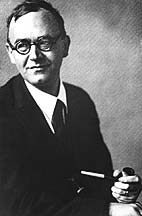
A brilliant aphorism on doubt:
"[Doubt] is altogether a pernicious companion which has its origin not in the good creation of God but in the Nihil — the power of destruction — where not only the foxes and rabbits but also the most varied kinds of demons bid one another "Good night." There is certainly a justification for the doubter. But there is no justification for doubt itself (and I wish someone would whisper that in Paul Tillich's ear). No one, therefore, should account himself particularly truthful, deep, fine, and elegant because of his doubt. No one should flirt with his unbelief or with his doubt. The theologian should only be sincerely ashamed of it."
Karl Barth, Evangelical Theology: An Introduction (Eerdmans 1992), p. 131.
Subscribe to:
Posts (Atom)