http://www.timenloe.net/?cat=36The Reformed Scripture Principle: Platonic Nominalism?
Friday, May 26th, 2006
[Continuing notes on Karl Barth, The Theology of the Reformed Confessions, trans. Darrell L. Guder and Judith J. Guder (Louisville and London: Westminster John Knox Press, 2002)]
After describing the difference between the Reformed and Lutheran churches as consisting in the Reformed being the church of the Reformation formal principle (sola Scriptura) and the Lutherans being the church of the Reformation material principle (sola fide) (pg. 39), Barth intriguingly suggests that the Reformed Scripture principle is fundamentally Platonic (pg. 45) precisely in its concept that Scripture always stands above everything else as an ideal to a shadow:
It should not be forgotten that behind Reformed theology, as especially clear in Calvin, stands Plato�s philosophy. This is no mystical Neoplatonism but rather rigorous and critical classical Platonism with the hard and inexorable lines of his doctrine of distance and relations, which in the Reformed world has entered into an unusual connection with the spirit of the Old Testament, which in this regard is oriented similarly. We shall often stumble upon this unmentioned background. There can be no doubt that the relation between Scripture and confession is both positively and negatively the same formally as Plato�s relation between the idea and the things. The strictest and most indissoluble relation between here and there is simultaneously the impassable polar region that divides here from there once and for all. This is fundamentally different from the catholic �continuous succession� [�continua successio�], as well as from the stairstep or background relation in which Scripture and confession are, in the Lutheran view, oriented to each other. (pp. 45-46)
At the same time, like the paradox earlier noted wherein the Reformed attach the quality of �biblical� to their views while at the same time admitting that their views are always open to revision, Barth sees the Reformed Scripture principle immediately making a paradoxically un-Platonic twist on its Platonic commitment:
It is, of course, completely unplatonic when then in Reformed theology the regulative idea is replaced by the regulative codex of the Old and New Testaments. The feeling is quite justified that this is not just an erratic stone that lies on the field but rather a meteoric rock. The Word of God is not the general truth of the relation between time and eternity, human and deity, nor is it the human�s indelible character of being in the image of God and in fellowship with God, nor the law of nature written at creation in the
human heart�All of that must be actualized by the Word of God, must be enacted by it. (pg. 46)
At the same time as the Word of God is �not the revelation of the relationship to infinity of human consciousness but of God�s thoughts become finite, of Jesus Christ� (pg. 46), the Bible is fundamentally isolated from the rest of the world precisely because it stands above all other authorities. Thus, unlike the Lutheran confessions, which are more accepting of external authorities, the Reformed confessions take an active interest in the issue of the biblical canon. For obviously they must identify the contents of the regulative codex if they expect to have one to set up as the above-all-else judge (pg. 49).
The paradox continues as the Reformed confessions lay out the absolute necessity of the guidance of the Spirit to administer the Bible as a self-contained, self-interpreting work of God. By invoking the Spirit in relation to understanding the self-contained words of Scripture, says Barth, �The positivist style of the Western European peoples in particular collides here with an unheard of supranaturalism, and merges with it into a unique totality; for the extremes touch each other.� (pg. 53). Furthermore, when it comes to grounding the Scripture principle, the Reformed answer �is an answer that, when examined in terms of synthetic thought, does in fact lead to emptiness, to nowhere. For it is nothing other than the repetition of the thesis for which grounds were sought, the acknowledgement that this thesis is an axiom whose content is established, or better preestablished by God.� (pg. 57). The Reformed justification for the Bible as the regulative codex is nothing other than �the Holy Spirit here (in the reader) connects to the Holy Spirit there (in the Scriptures� (ibid.).
Barth thinks it interesting that this fundamental aspect of the Reformed position seems in our own day to have been almost totally eclipsed by external arguments for the veracity of the Bible (pg. 58)�arguments which, although the Reformed confessions do note them they do not make primary. The fundamental grounding of the Scripture principle, in the doctrine of inspiration and its corollary that the Scriptures are autopistia (self-authoritative), means neither �the presence or the recognition of a historical fact as such,� nor �a subjective inward experience as asserted by the Enthusiasts back then and by the Romantics today,� nor �the self-evident character of a mathematical or other rational axiom� (pg. 63). It is instead �the revelation of God as a sovereign act, grounded solely in God, and emerging from God in freedom� (ibid.).
To me, this last sounds like the Nominalist insistence on the radical freedom of God, so it�s interesting that Barth has already identified the foundation of the Reformed principle in Platonism, a form of Realism. Furthermore, Barth argues that as the Reformed moved deeper into providing other reasons for the Scripture principle, �the recognition that we are known by God before we know him� disappeared, leaving them vulnerable to Lessing�s �ugly ditch� gaping between �eternal rational truth and contingent historical truth� (pg. 64). And a result of this was that �the Reformed formal principle had to become as opaque and unbelievable as the Lutheran material principle had become.� He thinks that after two centuries of biblical criticism, the only hope for Reformed Protestantism�and in fact Protestantism more generally�is to return to the �radical and paradoxical grounding through non-grounding� of the original Reformed position.


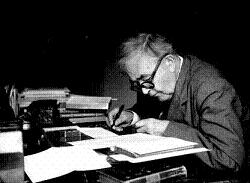 Karl Barth's